3. Great Falls (VA Lines)
Gauge Conditions
Runnable: 2.5 – 4.0 FT
very few run this in the upper 3's as a swim would be life threatening. Bad Hole at the top of the 2nd rapid. Spout goes on the far right.
Data from American Whitewater & USGS
Run Map
Description
Overview
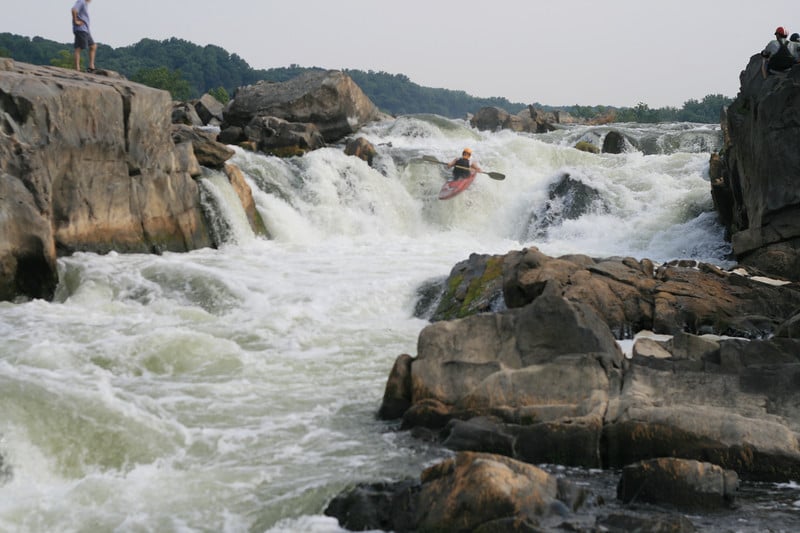
Great Falls of the Potomac River is a major set of rapids located about 15 miles upstream of Washington, DC. The main Falls lines drop fifty feet in one-tenth of a mile, creating a Class V+ set of waterfalls. In addition, a portion of the river flows around Olmstead Island in a channel called the Fish Ladder (additional channels flow at higher water).
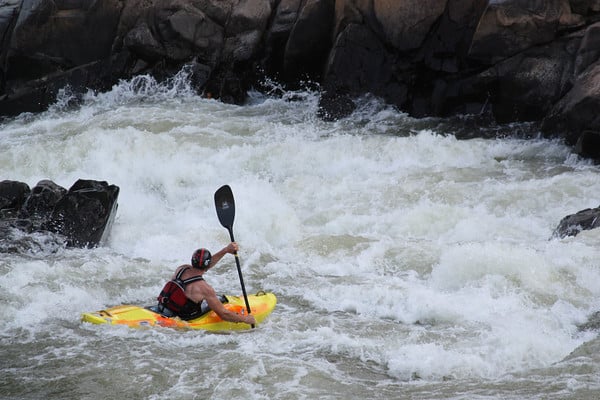
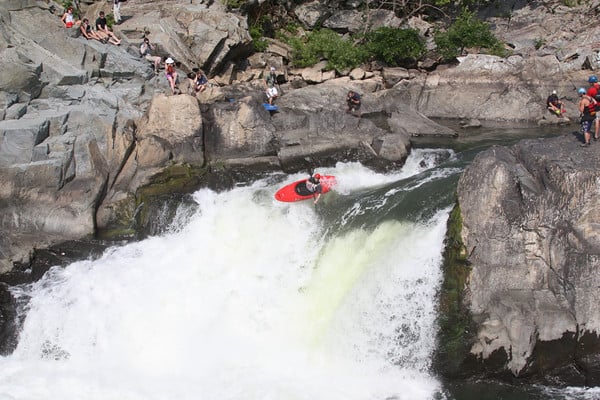
The Virginia Line is a classic sequence of technical whitewater leading up to a tricky 20' waterfall. This channel separates from the main channel at the top of the Flake Island. The top rapid, U-hole is probably the hardest and where most carnage occurs. The ideal line changes depending on the level. 40 years of waterfall hucking haven't made the spout any easier, but boat design probably has. The right line is now the standard line - either boofing over the hole entirely or reconnecting on a shelf. The left line is a good test of boat control. The Virginia side is runnable at high water but not recommended.
History
Paddlers have known about Great Falls as long as there has been whitewater kayaking. Many of the features -- such as the Spout, the Fingers, the Fish Ladder -- have names that predate paddling, in some cases by hundreds of years. But it was not until paddlers started running waterfalls regularly in the 1970s that paddlers began to seriously consider running the Falls. The first descent of Great Falls was made in 1975 by local experts Tom McEwan and Wick Walker, with the second descent by Steve McConaughy and Great Falls National Park Ranger Bill Kirby.
River Signals and Helicopters
The Park Service patrols the Potomac with a helicopter most summer weekends. In an effort to minimize confusion, the helicopter pilots are trained to recognize three signals from paddlers.
- Everything OK\- Tap the top of your helmet with one hand.
- Emergency - Wave both arms together over your head (like jumping jacks), holding brightly colored objects if possible.
- Need Medical Attention\- Form an X with arms or paddles.
Don't signal the helicopters unless you need them! And if being inspected, be sure to give the OK sign if you don't need assistance. Sometimes hikers call in "emergencies" that aren't actually emergencies.
Rapids in this Run (2)
Waterfalls (1)
Hazards & Portages (1)
Caution: The following locations may require scouting or portaging. Always check current conditions.
Difficulty
Class V
Length
0.4 mi
Gradient
100 ft/mi
max 500
Rapids
2
1 Hazard
Access Points
Shuttle Info
Most people park at Great Falls (MD) to run the falls. There is a $5 fee per vehicle to enter the park, or you can buy an annual pass for $20. The MD pass is honored on the VA side and vice versa. You can get directions by typing the address of the Great Falls Tavern Visitor Center into Google Maps or Mapquest:
11710 MacArthur Blvd.
Potomac, MD 20854
No shuttle is necessary. When you finish running the Falls, continue downriver and take out at Sandy Beach. Then walk back to your car via the towpath.
Difficulty Classes
I Easy
II Novice
III Intermediate
IV Advanced
V Expert/Extreme
VI Unrunnable
Permit Required
Access to the river is restricted on both the Maryland and Virginia sides.
Maryland Side - Paddlers may put in anywhere on the Maryland shore, but may not leave the boardwalk across Olmstead Island. To run the Falls from the Maryland side, most people put in above and run the aqueduct dam, or put in below the dam at higher levels.
Virginia Side - Paddlers may not put in upstream of the Falls. To run the Falls from the Virginia side you must put in at Fisherman's Eddy and then ferry and carry above both O-Deck rapid and the Falls themselves.
Carry up the Flake for multiple laps. If the rocks are wet, this can be sketchier than running the Falls.
Running Great Falls is currently unrestricted. However, to maintain good relations with the National Park Service paddlers voluntarily restrict their runs to less populated times in the park—early morning, late evening, or weekdays—and limit group size and time spent in the rapid.
The Park Service is concerned about running the Falls at popular times because it can draw spectators down off the observation decks and closer to the river's edge -- where they might fall in the water and drown. And, if paddlers spend a lot of time running around and relaxing in the Falls, it can give the impression that such activities are not very difficult or dangerous. Since 1975, at least 30 people have drowned in Great Falls, so the Park Service is understandably nervous about this.
For more information, see the Guidelines for Running Great Falls as written by the Canoe Cruisers Association in 1999. Today regular Falls runners continue to dialog with the Park Service to make sure access remains open to all.
Current Conditions
5-Day Forecast
Whitewater data from
American Whitewater
American Whitewater