Dimple
Save this feature with the run it belongs to.
Gauge Conditions
Arguably most difficult at 4-5'. Above 5', things begin to wash out, though there are some BIG holes and waves.
Photo
Description
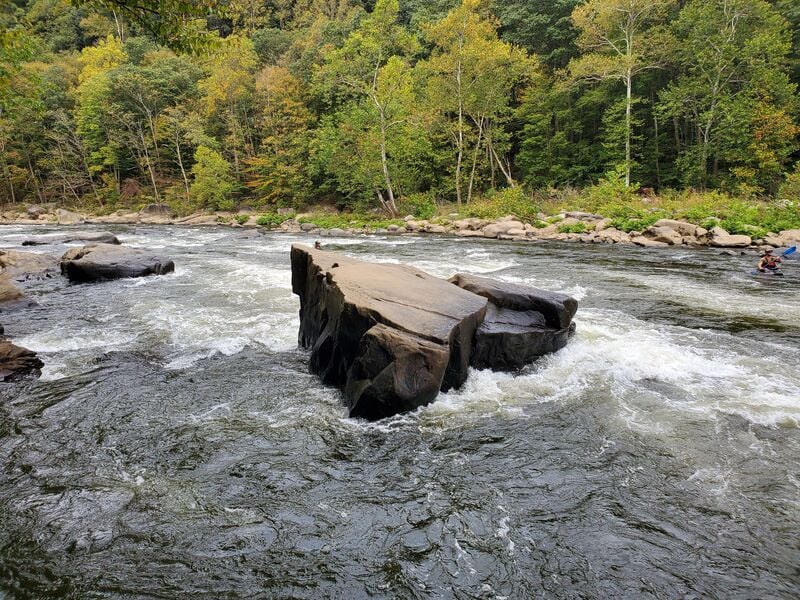
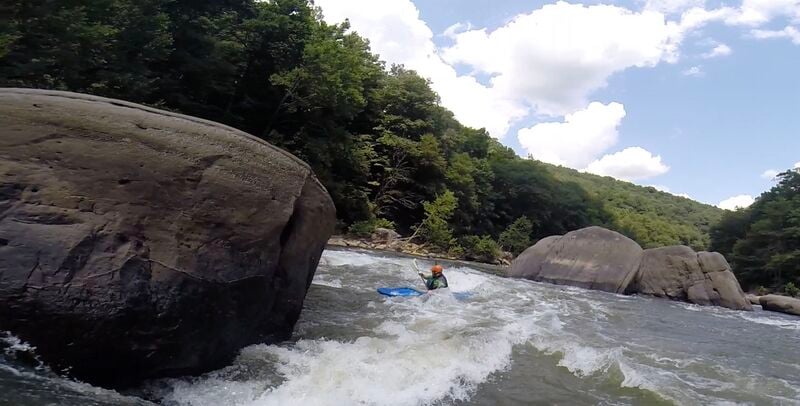
"Dimple" Rock is notorious because of its propensity for flipping boats. Thousands of rafting customers (and a fair number of hard boaters) swim here every year. The standard line at 'Dimple' is to follow the current at far river left, drifting toward "Dimple" Rock while pointed somewhat to the right, then driving into the eddy behind "Pinball" Rock (upstream and right of "Dimple") as soon as you pass the guard rocks. It's a fairly straightforward move for experienced kayakers, and for raft crews that work well with each other and pay attention to their guides. The issues are: 1) that a paddler has to focus on the eddy behind "Pinball" and not on "Dimple" Rock and 2) it is a little tricky to time the move from the current through the eddy - too early and the upstream eddy current pushes you into "Pinball" - too late and you hit the pillow on "Dimple" (Either of which is manageable if you keep a cool head and keep paddling).
There is an undercut on 'Dimple' Rock, just to the left of the pillow. " Between 1983 and 2003, there were eight drownings in those ["Dimple" Rock] rapids. Since 2003... [a drowning in 2022]... was the only one." ( statement by Ken Bisbee - Park Manager at DCNR/Ohiopyle State Park in 2023). Most of these drownings have been rafting customers are washed into and become fatally trapped by the undercut . There's a sneak to the right of "Pinball" Rock and left of the larger "Vulture" Rock for those who want to take no chances and at higher levels there's a line to the right of "Vulture" Rock, as well. There is the option to portage: The park has created a portage that starts at the rock beach on river right and follows a trail to put in below 'Dimple.'
The "Dimple" approach can change at different water levels. At very low water there is a ledge and hydraulic on the left side of the approach that makes it more difficult to achieve the correct right angle on the approach to the "Pinball" eddy; also the undercut is more exposed at low water, which can make it more dangerous if one is out of the boat and shoved to the left and into the rock (This concern is greater for the occupants of rafts and duckies than for hard boaters who rarely swim on the approach). At moderately high levels, a boil forms at the foot of the "Pinball" eddy that can flip boaters making the eddy turn. At still higher levels there are more route choices and exactly where you are relative to "Dimple" rock may not be the main focus of your attention.
Below "Dimple" Rock there are a series of rocks to dodge and a riverwide ledge to find slots to pass through.
Location
Other Rapids on This Run (20)
 Rapid
II+
Rapid
II+
 Playspot
III
Playspot
III
 Rapid
II
Rapid
II
 Rapid
III+
Rapid
III+
 Rapid
II+
Rapid
II+
Current Conditions
5-Day Forecast
American Whitewater