5. First Crossing to Common St. (6 miles)
Gauge Conditions
Runnable: 250.0 – 6,000.0 CFS
Data from American Whitewater & USGS
Run Map
Run Time Estimate
Select put-in and take-out to estimate time.
Plan This Trip
See wind-adjusted speed maps, forecast planning, and detailed time estimates.
Sign in to generate an AI timing estimate for this run.
Whitewater timing varies with scouting, portages, and group pace. Use as a planning baseline.
Description
The Lower Guadalupe is fed from a bottom-release dam ( Canyon Dam), and thus it almost always runs relatively clear and cold (60 degrees at the dam.) During the summer months, if the dam release is at "recreational" levels (< 750 cfs), the river will be clogged with tubers. Referring to this article, The Guadalupe-Blanco River Authority controls the releases from Canyon Dam whenever the lake level is 909' or below, and when this is the case, typically the releases will be geared toward tubing (no more than 750 cfs, and usually much lower) during the summer months. During periods of drought, the GBRA will release only the minimum necessary to maintain the health of the Matagorda Bay estuary and fulfill downstream water contracts (about 50-75 cfs.) When floods occur on the Upper Guadalupe and the lake gets above 909', the Army Corps of Engineers takes control. If the lake level gets too high, then they will attempt to lower it to 909' as quickly as they can, which usually results in days or weeks of 3000-5500 cfs releases downstream (5500 cfs is the maximum dam release.) However, the Army Corps must also ensure that the release, when combined with natural flows, does not exceed 12,000 cfs at Cuero, Gonzales, and Victoria. During big dam releases, the Lower Guadalupe becomes a playground for rafters and whitewater kayakers, but unfortunately this only tends to happen every few years, and extended multi-week big releases only tend to happen once or twice every decade.
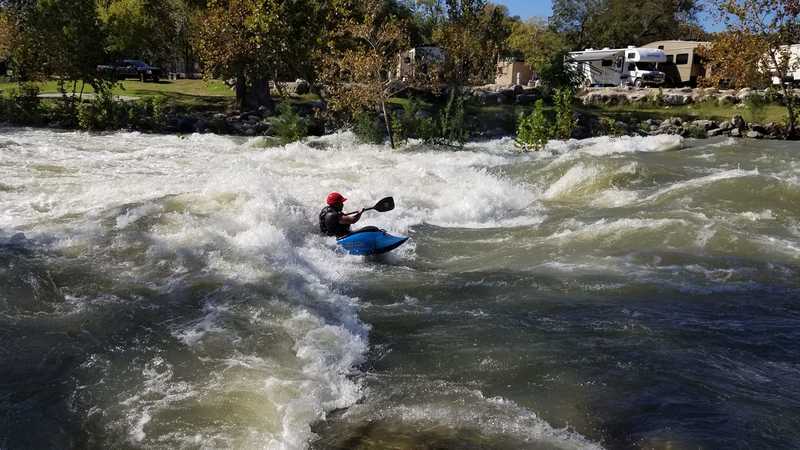
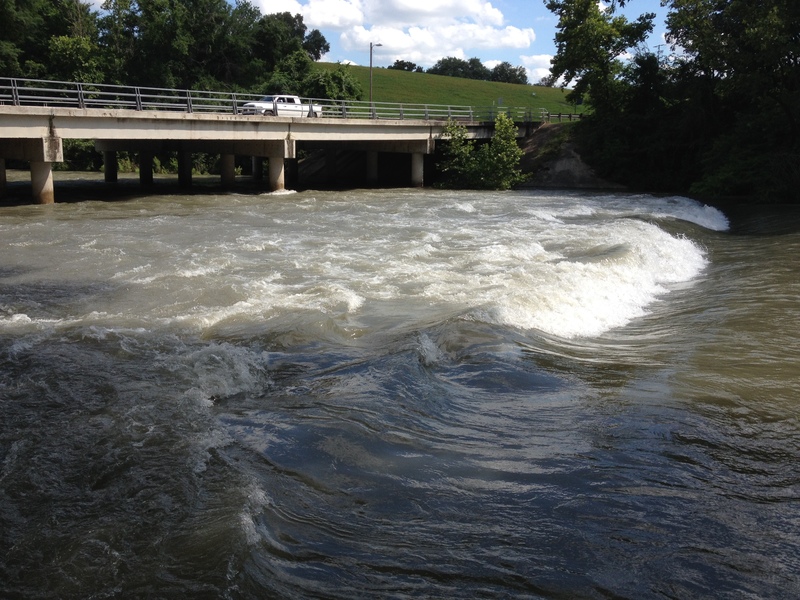
First Crossing to Common St. is the most continuous stretch of the Guadalupe (although "continuous" is a relative term here-- there are still a lot of big pools.) That fact, combined with the fact that the Lower Guadalupe is the only dam-controlled whitewater river in Central Texas, makes this stretch very popular with all types of river users. At lower levels (up to 1200 cfs), it provides a perfect setting for learning whitewater basics, and at thousands of cfs, it starts to feel like a proper whitewater river, with crisp eddy lines, big wave trains and reactionaries, and some good play waves. The most technical level for downriver paddlers is between 2000 and 4000 cfs on the Common St. gauge, because most of the big rocks are just barely under water. 2500-3500 cfs (Common St. gauge) is generally the best level for play. This stretch of river has been successfully run by kayakers at levels as low as 125 cfs, but boaters will generally scrape the bottom of the river on some of the rapids when the flow is less than 250-300 cfs.
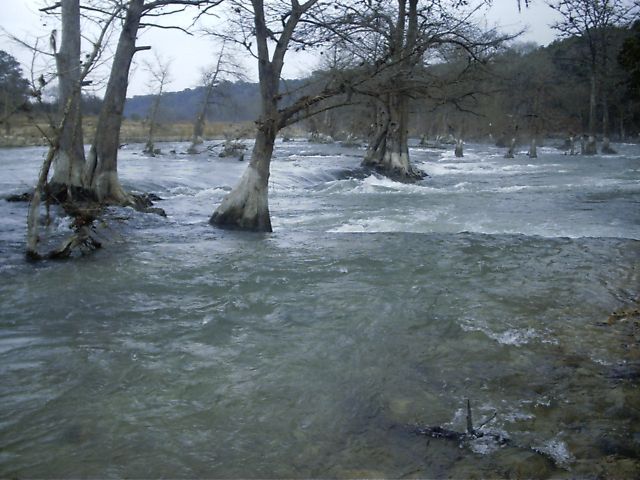
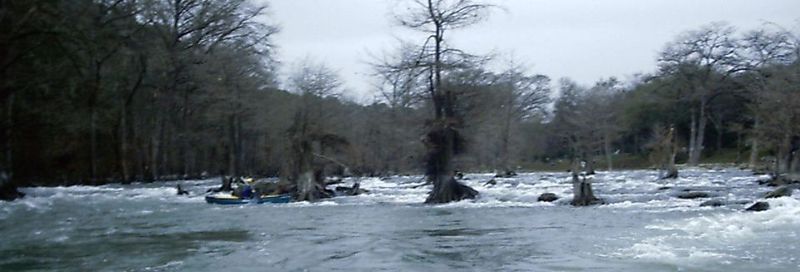
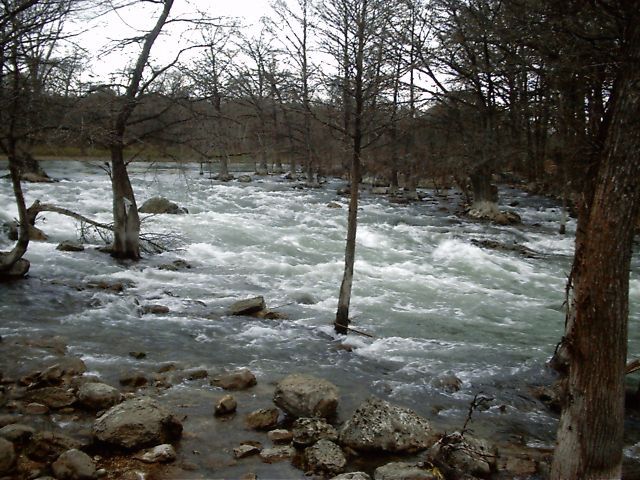
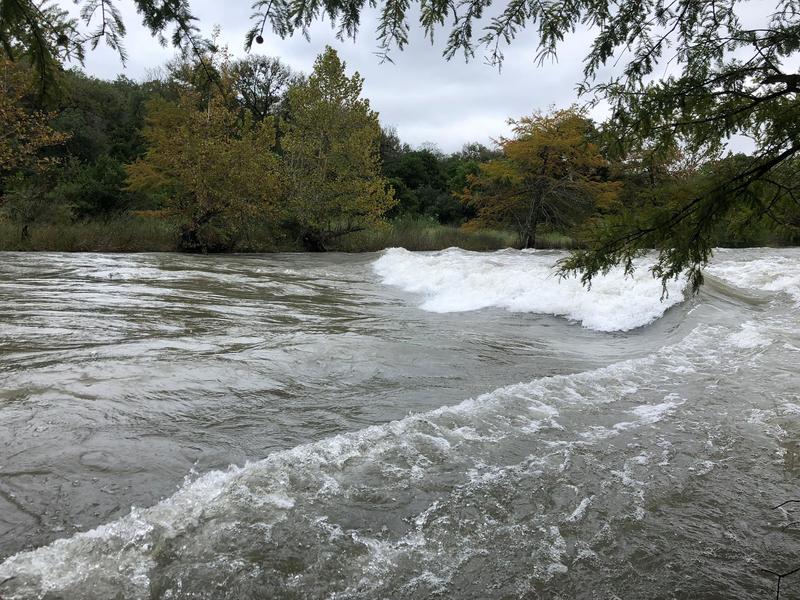
The Guadalupe is a pool-drop river, and the rapids are typically formed from rock piles or shallow limestone ledges. Below Gruene, however, there are also some rapids that form from cypress trees growing in the river bed.
There are basically no public access points on the Lower Guadalupe between Canyon Dam and Common St., so putting in at First Crossing will require paying a fee to one of the outfitters located on either side of the river. Many paddlers shorten this run to 3.75 miles by taking out at Gruene. You can park at one of the river outfitters in Gruene and pay them a fee, or you can avoid a fee by parking along New Braunfels St. in Gruene and hiking your boat 200-300 yards up the hill after you take out.
Distances and gradient measured using GIS tools in 2015.
This video shows the named rapids between 1st Crossing and Gruene at full dam release (5500 cfs.)
Rapids in this Run (5)
Hazards & Portages (1)
Caution: The following locations may require scouting or portaging. Always check current conditions.
Difficulty
Class II+(III)
Length
6.2 mi
Gradient
12 ft/mi
Rapids
5
1 Hazard
Access Points
Difficulty Classes
I Easy
II Novice
III Intermediate
IV Advanced
V Expert/Extreme
VI Unrunnable
Current Conditions
5-Day Forecast
Whitewater data from
American Whitewater
American Whitewater