Hueco Falls
Save this feature with the run it belongs to.
Gauge Conditions
Photo
Description
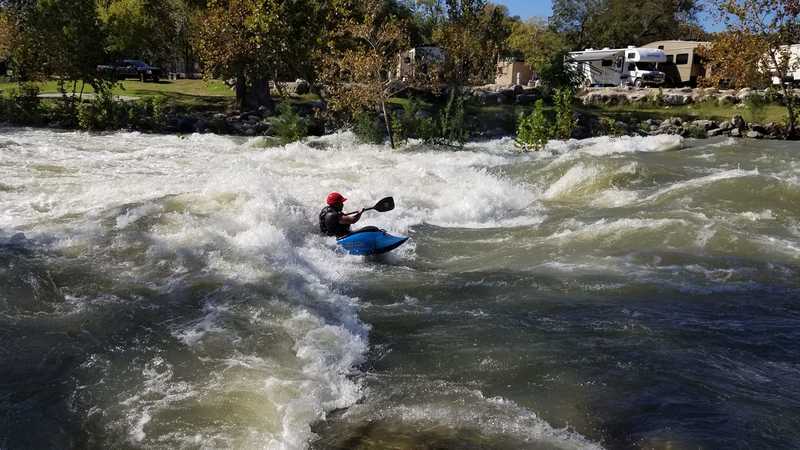
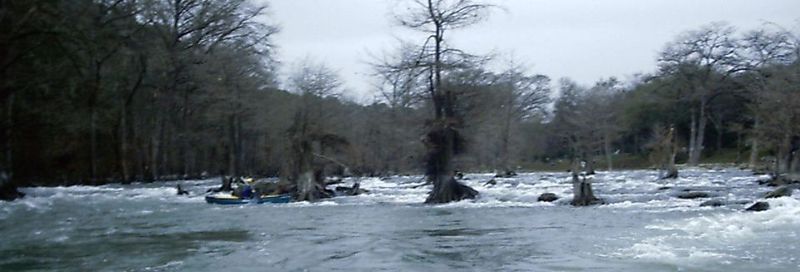
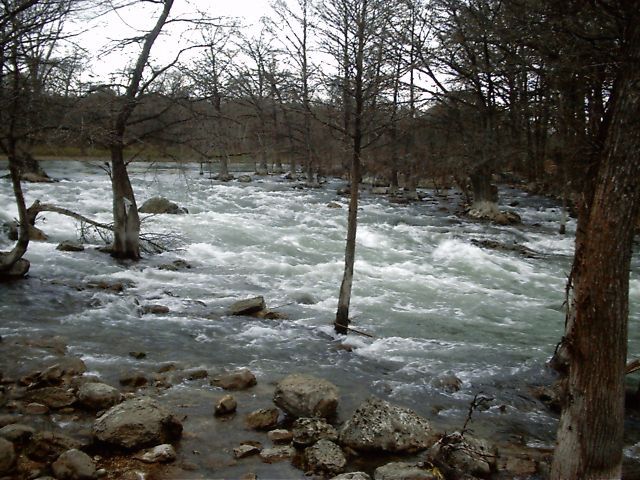
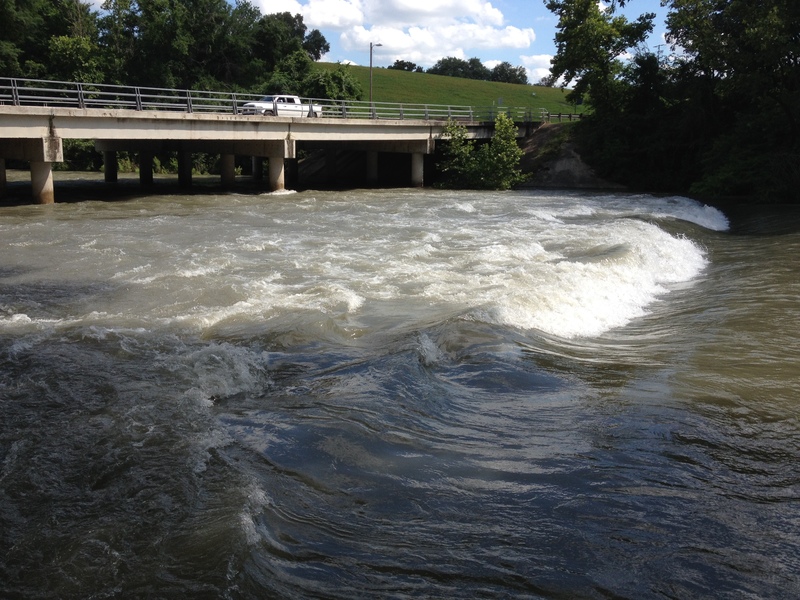
Hueco Falls is really the only named rapid on the Guadalupe that merits a Class III rating. Paddlers generally run river left to avoid the large boulder at river right. At lower flows (<= 1000 cfs), the rapid as a whole is more of a Class II+/III-. Enter near the center of the river and work left, S-turning down a couple of shallow ledges. At higher flows, a wave train forms at river left, and the line becomes more straightforward. At 3000-5000 cfs, the river left wave train becomes large and irregular, and the river right boulder forms a nasty hole. The hole is grabbiest at around 3000-3500 cfs, when water is just barely over the rock (at least one expert whitewater kayaker is known to have received a proper beat-down and taken a swim here as the result of a failed boof attempt.) At the same level, a large reactionary wave forms between the hole and the wave train, and it can ender a playboat or swamp an open boat that ventures too far right. Make no mistake-- the Hueco hole is a feature worthy of a Class IV rapid, and it will give you a Class IV beat-down, but you would first have to miss the entire half of the river where the hole isn't.
At around 1000-1200 cfs, a sneak line opens up to the right of the boulder (between the boulder and the rock garden, which is mostly submerged and adorned with saplings in the above photo.) However, inexperienced paddlers (particularly those in open boats) should not attempt this line, as the boulder has high pin potential (make a fist, Christopher.) At higher flows (example: 3000-3500 cfs), when the hole is in, this line becomes a one-boat-wide Class IV hero line that requires paddling over the shoulder of the hole. Paddlers without solid Class IV+ river running and hole extrication skills should never attempt this line when the hole is in, and setting safety is recommended.
At very high flows (multiple thousands of cfs), a Class II sneak line opens up at far river right (hugging the right bank, to the right of the rock garden that is to the right of the boulder/hole.) This line is known to be in when a full dam release (5000+ cfs) is occurring.
At around 500 cfs, a shallow side-surf spot opens up at river left behind the drop. As the flow increases, the wave-hole becomes deeper and turns into more of a proper play wave, reaching its ideal level at somewhere between 2500-4000 cfs. At 2500-3500 cfs, it is a very bouncy front-surfable irregular wave that can give up other tricks to those with good playboating skills, but generally it it not very retentive. At higher flows, the wave becomes bigger but harder to catch.
At 2500-3500 cfs (and possibly lower levels), the ledge above the main wave also becomes playable. Boaters can catch this ledge on the fly or portage up from the eddy next to the main wave.
Location
Current Conditions
5-Day Forecast
American Whitewater