Bland (Route 608) to New R. (Route 636)
Gauge Conditions
Runnable: 350.0 – 5,000.0 CFS
Best boatable flows uncertain. Help out by adding a comment or report.
Data from American Whitewater & USGS
Run Map
Run Time Estimate
Select put-in and take-out to estimate time.
Plan This Trip
See wind-adjusted speed maps, forecast planning, and detailed time estimates.
Sign in to generate an AI timing estimate for this run.
Whitewater timing varies with scouting, portages, and group pace. Use as a planning baseline.
Description
There are multiple sections to paddle on Big Walker Creek, with 50 miles of stream from near Bland to the confluence with the New River at Ripplemead. All of the rapids are straightforward and do not exceed class II at moderate flows.
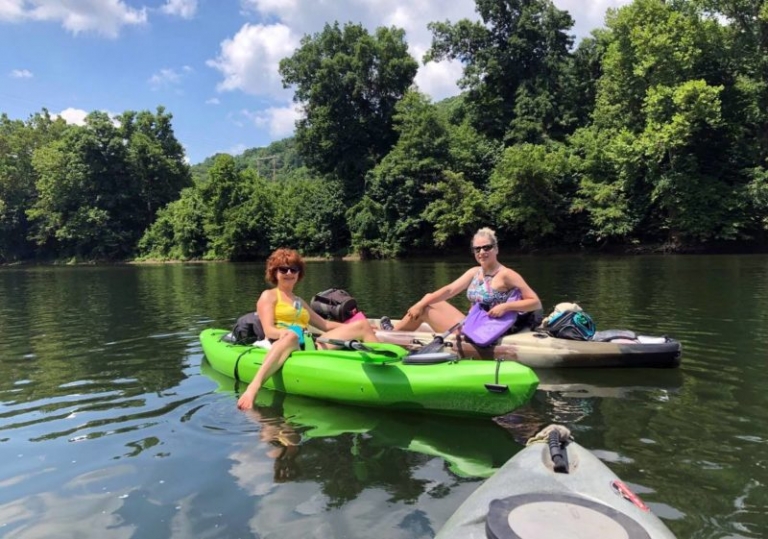
The most popular and scenic section is the lowermost 8 miles between Farley Wayside park on Hwy. 100 near Staffordsville to the Ripplemead takeout on the New. The first half (to the Rt. 622 bridge) features several streamside cliffs. Below Rt. 622 the creek is more remote and in the spring and summer is a beautiful green tunnel. It is possible to paddle only the first half (4 miles) if you are short on time or want to do a bike shuttle (2.5 miles using Rt. 708). The full section requires a 10-mile shuttle through Pearisburg (not bikeable). This section requires about 350-400 cfs at Bane; ideal flow is 600-900.
The next section upstream is from Poplar Hill (Hwy. 100 bridge) to the low-water bridge upstream of Farley Wayside. This section is 8 miles with a shuttle of less than 5 miles. There is a good put-in on the upstream side of the Hwy. 100 bridge at a large gravel pull-out. The Little Walker Creek confluence is on the downstream side of this bridge, adding significant flow. Near the end of this section, the creek passes under another Hwy. 100 bridge (no access) and the next mile or so down to the takeout has a nice series of rapids. The takeout is at a low-water bridge (Rt. 749) a half mile upstream of Farley Wayside. Since this requires a portage, plus an easier exit and shorter boat carry, most people prefer to take out here, or you can continue to Farley Wayside. 400 cfs should be enough.
White Gate to Poplar Hill is 11 miles with two portages. The first is a 6-foot low head dam which can be seen from Rt. 733 (Old Mill Dam Rd.) Portage river left where it's easy to step out onto a concrete structure. Since the first 4 miles are mostly flatwater, and a portage of the dam is required, a better put-in would be along Rt. 42 near the Volunteer Fire building, though most of the land appears to be posted. Below this point, the creek makes a 3-mile W-shaped loop away from the road that is the best part of this section, with unbroken forest and frequent rapids, before returning to Rt. 42 for a short time. In this roadside section there is an access where a spring flows through a large concrete culvert. The second portage is a low water bridge not far above the takeout (there's a suspension bridge here as well). However, this low water bridge is relatively benign, and with sufficient water can be run along the right bank (but portage left). The shuttle is 7 miles- north on Rt. 100 for a half mile and then left on Rt. 42 to White Gate and the intersection with Rt. 670. The best put-in is probably the concrete bridge a short distance up Rt. 670. 600 cfs is probably a good minimum.
Above White Gate, it is possible to paddle from near the Kimberling Creek confluence down to White Gate. This section is 5.5 miles with some nice rapids near the end, right at the Rt. 667 bridge and just below as the creek makes a 180 degree bend to the left. The shuttle is about 3.5 miles along Rt. 670 (Flat Hollow Rd.) and bikeable. 600 cfs is the likely minimum.
Further upstream, Big Walker is smaller, since Kimberling Creek doubles the flow, and you'll likely need 1000 cfs or more at Bane.
From Rt. 738 (Byrnes Chapel Rd, just south of Mechanicsburg) to the Kimberling Creek confluence is 8 miles. The first half is a relatively flat float through cow pastures. Rt. 640 (Trails End Dr.) is alongside on the left bank and may offer opportunities to shorten the flatwater. Shortly after Rt. 640 leaves the creek, there is a low water bridge (portage left). Here begins the fun second half of the trip, with three miles of fairly continuous rapids in a mostly wooded micro-gorge. Though it is all class II, this section probably has more whitewater than any other part of Walker Creek. There's one small drop with a horizon line that may be worth looking at, with a hole on the left side that could get strong at high water. When you reach a long straight pool, the fun is over and Rt. 670 (Mt. Zion Rd.) comes down to the right bank, with take-out opportunities. If you continue to the confluence of Kimberling Creek just downstream, be aware of at least one low-water bridge requiring a portage.
Further up the creek, you can paddle 5.5 miles from the upstream Rt. 608 bridge (near Central United Methodist Church) to the downstream Rt. 608 bridge. This is a mellow float through pastures at first and then through a nice wooded area. Be on the lookout for wires/fences crossing the creek.
Near Bland, Rt. 604 crosses the creek 6 times over 7 miles, so you can choose your own trip. However, these upstream sections have lots of cow pastures, many cleared all the way to the creek. Around Bland and especially west of I-77, the Walker headwaters are a sad sight as they flow through pastures with no shade, every tree and bush removed from the banks.
See Also:
*Virginia Whitewater*, Roger Corbett (2000 ed.), p. 445.
*Exploring Virginia's Waterways*, Ed Gertler (2022 ed.), p. 349.
Rapids in this Run (9)
 Rapid
Rapid
Access - Rt. 608 bridge
Rapid
Access - Rt. 738
 Rapid
Rapid
Access - Rt. 670 Mt. Zion Rd.
 Rapid
Rapid
Access - Kimberling Creek confluence
Rapid
Access - Old Church Ln bridge
Rapid
Access - Spring along Rt. 42
Rapid
Access - Rt. 100 at Little Walker Creek
Rapid
Access - Rt. 749 low water bridge
Rapid
Access - Farley Wayside park
Hazards & Portages (2)
Caution: The following locations may require scouting or portaging. Always check current conditions.
Difficulty
Class I-II
Length
50.0 mi
Gradient
12 ft/mi
Rapids
9
1 Hazard
1 Portage
Access Points
Difficulty Classes
I Easy
II Novice
III Intermediate
IV Advanced
V Expert/Extreme
VI Unrunnable
Current Conditions
5-Day Forecast
Whitewater data from
American Whitewater
American Whitewater