Walnut Creek Metropolitan Park to Sprinkle Road (5.1 miles)
Gauge Conditions
Runnable: 300.0 – 3,000.0 CFS
Upper limit of recommended boatable flows uncertain. Please contribute a comment or report.
Data from American Whitewater & USGS
Run Map
Run Time Estimate
Select put-in and take-out to estimate time.
Plan This Trip
See wind-adjusted speed maps, forecast planning, and detailed time estimates.
Sign in to generate an AI timing estimate for this run.
Whitewater timing varies with scouting, portages, and group pace. Use as a planning baseline.
Description
Walnut Creek is best known as the creek that flows through Walnut Creek Metropolitan Park (the singletrack trail system in the park crosses the creek twice.) It is rarely more than a trickle, but with the right amount of rain, Walnut becomes a fast, continuous, and fun Class III creek with some good play and relatively low consequences. An ideal level for whitewater boating seems to be at 1000+ cfs on the Dessau Rd. gauge, with the play features becoming more optimal toward 3000 cfs. At this level, the first three miles of the run has very little flat water and contains numerous big, long, and often irregular wave trains, a handful of good surf spots (most catch-on-the-fly, but a couple of them have eddy service), as well as some really crisp eddy lines and even a whirlpool or two. At higher levels, the features get bigger and faster, and there is less play, but the creek does not generally increase in difficulty.
Most paddlers put in below 'Piton Dam' in Walnut Creek Metro Park (the Class III rating assigned to this run assumes portaging that dam.) This allows you to enjoy 0.6 miles of Wells Branch, a twisting, tight, and shallow Class III tributary of Walnut that drops 50 feet per mile over some smooth limestone features before confluencing with Walnut right at Lamar Blvd (for those who have hiked or biked in Walnut Creek Metro, Wells Branch is the creek the flows next to the 'Windy Loop', 'BMX', and 'Severe Consequences' trails.) Because Wells Branch is a narrow channel and doesn't flow very often, there tend to be strainers in this section, so watch out for these. The beauty of Wells Branch is that, despite being a steep creek, it is entirely runnable in a playboat. Since the creek flows at a steady downhill gradient, there are no significant holes, drops, or other obstacles that would necessitate the use of a creek boat, and in fact, using a big boat could be a liability, since it would make it more difficult to execute tight turns.
Although Walnut Creek and Wells Branch tend to be low-consequence, because of their continuous nature, a swim here could be a real pain. Eddies tend to be small and require good boat control to catch. For an experienced boater, all of the rapids should be 'read-and-run'. Most of the rapids on the main creek would, in isolation, probably only be deserving of a II+ or III- rating, but the continuous nature of the run in general makes it worthy of a Class III. The Wells Branch section is more technical and definitely deserving of a III when Walnut Creek is above 1000 cfs.
Distances and gradient measured using GIS tools in 2015. Maximum gradient (48 fpm) is on Wells Branch, from the put-in to the confluence. The remaining gradient is 11 fpm from the confluence to the Dessau Rd. bridge and 16 fpm from Dessau Rd. to Sprinkle Rd.
NOTES:
- Texas Whitewater suggests putting in at Parmer Lane, which adds another 0.6 miles on Wells Branch, but access and parking at Parmer is poor, so most paddlers opt to put in at the park. There is no recent beta for the section between Parmer and the park.
- Since the creek flows rarely and tends to drop quickly, paddlers usually opt to run the 3 miles between the park and Dessau to get the most 'bang for their buck.' The 2 miles below Dessau Rd. has little in the way of whitewater features, other than a low-head dam that is known to be dangerous.
- Texas Whitewater incorrectly calls the takeout 'Cameron Rd.' (Cameron Rd. runs into Sprinkle Rd., but the takeout is on Sprinkle.)
Rapids in this Run (4)
Waterfalls (2)
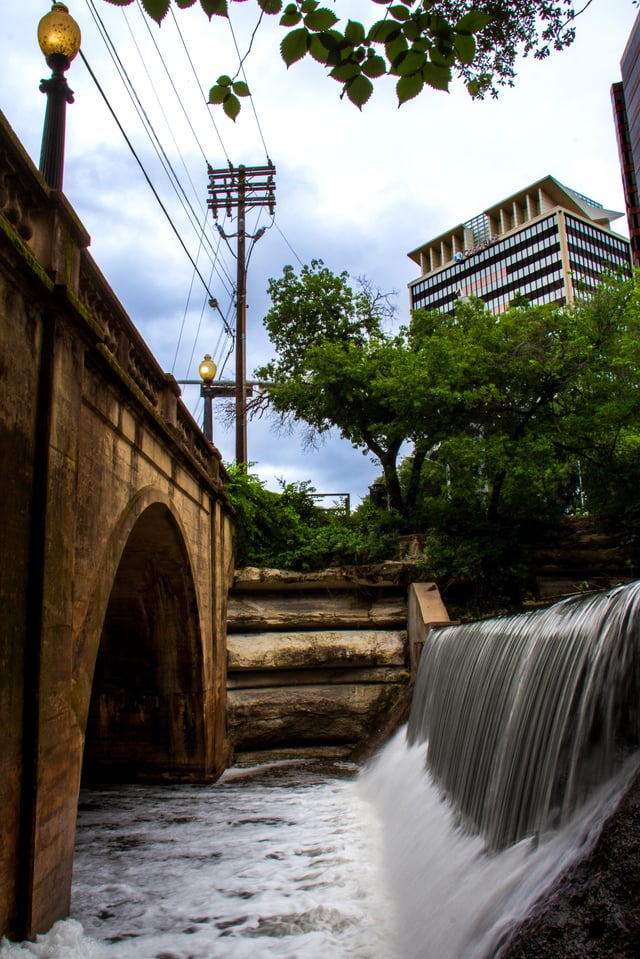
Hazards & Portages (1)
Caution: The following locations may require scouting or portaging. Always check current conditions.
Difficulty
Class III
Length
5.1 mi
Gradient
18 ft/mi
max 48
Rapids
4
1 Hazard
Access Points
Difficulty Classes
I Easy
II Novice
III Intermediate
IV Advanced
V Expert/Extreme
VI Unrunnable
Current Conditions
5-Day Forecast
Whitewater data from
American Whitewater
American Whitewater