Rock Slide Rapid
Save this feature with the run it belongs to.
Gauge Conditions
Too low for reasonable whitewater trip.
Photo
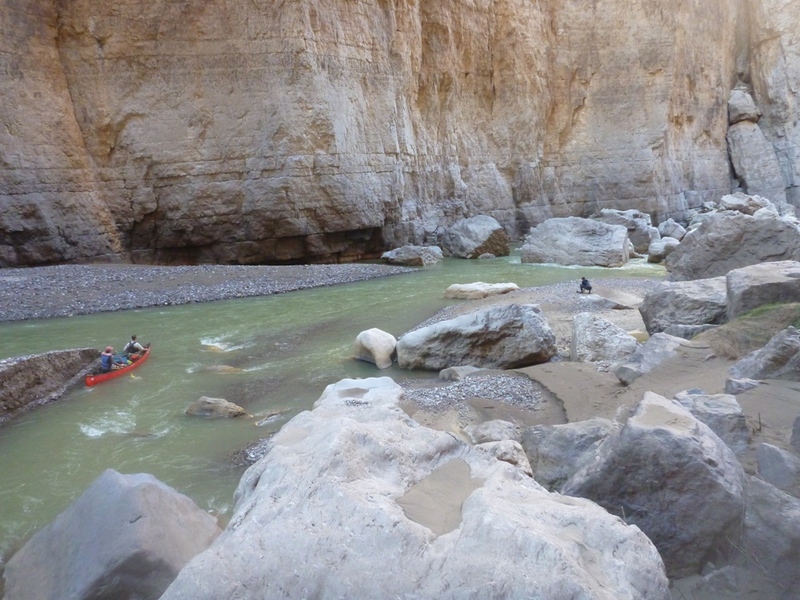
Description
Rock Slide is definitely challenging for recreational canoes and can be challenging for beginner kayakers (particularly those paddling recreational kayaks), but it also tends to be over-hyped. At low to moderate levels, the flow is slow, and there are plenty of huge eddies to catch. Make no mistake-- the rapid has some dangers (particularly undercut rocks), and numerous paddlers have wrapped canoes or yard-saled sit-on-tops here, but it should be a relatively straightforward "read and run" for most whitewater paddlers. Scout or portage from the large rock pile at river right.
Most of the instructions below apply only to low or moderate flows. At the top, you can either go far right around the rocks ("Mexican Gate") or left ("Texas Gate.") At moderate flows, another line opens up at the center. Eddy out below the gates. From here, there is usually only one line-- through a slot at the center of the river. From the Texas side, the current will try to push you into the boulder left of the slot, so either ferry across and approach the slot from the Mexican side, or peel out into the current so you can stay to the right of the flow.
Below the center slot, there is a large pool. The channel then splits again around another prominent boulder. Left of the boulder is "Bottle Neck" (a tight squeeze at low to moderate flows) and right of the boulder (far river right) is "Dog Nose" (a larger channel.) Below Bottle Neck/Dog Nose, start working left to go between a couple of pairs of exposed rocks, then the paddle out should be straightforward from there.
Undercut rocks and sieves are a risk in Rock Slide, particularly at low levels. In general, if you swim, swim through the channel that you would have taken with your boat.
At high flows (thousands of cfs), the rocks become submerged and form holes, and the "gates" and "slots" become tongues. At these high levels, there are some tricky hydraulics and eddy lines around some of the holes, and the holes may not be apparent from upstream because of the siltiness of the water. However, the lines around the holes are also straightforward, and the holes themselves are not particularly grabby.
Location
Other Rapids on This Run (10)
Current Conditions
5-Day Forecast
American Whitewater